 Episode 9
· 01:02:02
Andrew (00:04)
Welcome to Gardens of Earthly Delight, the podcast dedicated to exploring our connection to Earth. I'm Andrew Valenti. Every episode I sit down with someone whose work puts them in contact with the earth, and through these conversations I aim to create as many paths as possible for you to find your own way to connecting with the natural world.
Andrew (00:25)
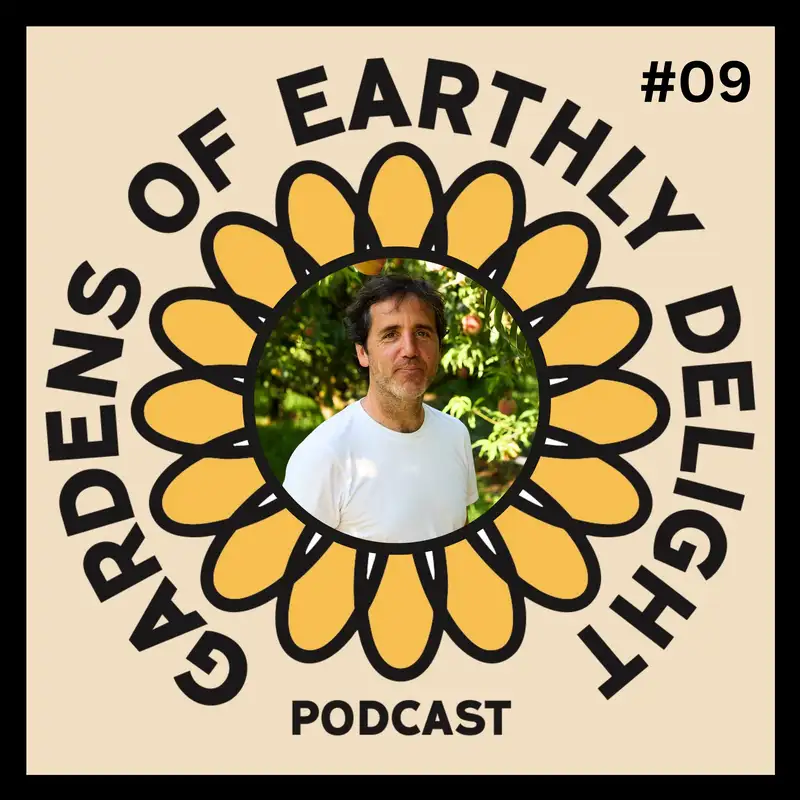
Most of us are trained to reach for the best looking produce on the shelf. No blemishes, no scars, uniform in shape and texture. My guest today will tell you that the fruit we are passing over is almost always the better one, and that there is a reason all of us learn to choose wrong. Franco Fubini is the founder and CEO of Natoora He has spent over two decades building a supply chain that puts flavor first, working directly with growers across Europe, the US, and Australia.
and supplying some of the most famous restaurants in the world. He wrote a book called In Search of the Perfect Peach, which I absolutely loved. The chapter on winter tomatoes has stayed with me since I read it and I genuinely recommend the book to everyone.
We get into why the varieties we lost were never the ones that were hard to grow. They were the ones that were hard to fit into a supermarket. We talk about how you learn to taste and what it takes to trust your food when there is no label doing that work for you. And he shares one of his favorite food memories that will have you yearning for the Italian coast and the simplicity of our summer meal.
Andrew (01:34)
when you were a kid, I'm curious what food actually meant to you. And if there was a time in your life that you can remember when you started to think about food for yourself.
Franco (01:45)
So what it what did food mean to me? you know, no one's ever asked me that. I always had a good connection with food, I guess is the way to put it. food was never this kind of really important thing, but at the same time, it was never nothing. And I say it wasn't this important thing because in my family food just was always a
just was always a a kind of constant. You know, we we my mom cooked, like we we we always we always had a a good connection with food without it being this like really important thing kind of you know out of measure. so I think it you know food for me was I guess joy and happiness is what it meant to me as a as a kid and you know one of the things that I remember we we left Argentina very early on.
was like four years old. but when I if you if you fast forward a little bit to kind of my high school years so as I become kind of early teenage years one we were back in Argentina and barbecues asadas were an important thing. It's just an important part of our culture. And I think
That was around the time that I started, you know, to answer your second question, which is like, you know, when when did I, when did it start taking on, I guess, meaning is I I started cooking for myself during high school. It was like a the kind of beginning of taking ownership for the food that I ate. And particularly
the home cooked food that I ate, if that makes sense.
Andrew (03:22)
Yeah.
What were some of the first things that you do you remember like f first dishes?
Franco (03:26)
Yeah.
Well there's this one thing that I that I that I had a which is I I laugh now 'cause a bit it's a bit mad, but it kind of spe it does speak to flavor and simplicity in a way. And so I I've I've I have to say that in Argentina back then you're talking about you know the the the late eighties, very early nineties, Argentina being a a a a good meat producer.
there's a brand called Pati, which is still exist, that made hamburgers that were frozen. they're you know pretty good quality hamburgers. I don't know now, but back in the day they were they were they were very good. And we always had some of that in the freezer, and I used to just grill those and then I would cut them with a knife, just like not fully cut, but just a little incisions, and then I would pour vinegar on it, and I would have that when I'd come home from school.
Andrew (04:21)
Simple.
Franco (04:22)
Simple and you know, vinegar's great, acidity and yeah, so meat with vinegar. I haven't done that in you know since I was in Argentina as a as a fifteen year old, but yeah.
Andrew (04:34)
Yeah,
on. So you grew up or you traveled and lived in a whole whole bunch of different places.
Franco (04:40)
Yeah.
Andrew (04:41)
place is really interesting to me. and especially when it comes to food because there's such identity with food and place. for you, when it comes to place and and belonging and just really connecting with place.
And having lived so many different places, what does that what does that spark in you? Like what is what does place really mean for you to be from a place or even to be like of a place?
Franco (05:08)
it's interesting because I like I don't ha everyone always asks me like where's home and home is where I'm living at the time. And this has been true throughout my life because I you know, I was asked that the other day actually and I like, Well you know, home's home's Brooklyn now, it's New York. but if I remember having these conversations when I was, you know, in my twenties and it was the same thing. It's like, well, I'm I'm living in Philadelphia now or I'm
Living in New York, you know, after university, and and that's home. So for me, place has always been, I guess, where I am. And I've always looked at place through the through the lens of food as well, because and I I talk about this in in the book, and I I I say this because I I thought a lot about
Why why food systems are a certain way in in certain parts of the world? And then inevitably it led me to culture and place. It's like why I don't know, why does a place like Italy behave the way it does versus a place like England? Why are why why do we have a lot of diversity in in agriculture in Italy and less so in in England? And I think that all that all goes back to place and
food culture or th or the food component of that place is culture is is a better way to better way to to define it. So
I guess connected to your to your earlier question, for me, when I think back through the different places I've lived in, I have very vivid memories, food memories, of those places that are representative of that local culture. And I think that maybe is natural in how I'm wired, but I think it also defines that.
food connects people in a certain way. food is always at the center, and it doesn't matter where in the world you are, food has always been at the center of how we as humans celebrate, how we as humans connect. it's a center of kind of families coming together. so even though food should never be
outwardly important, it actually carries a tremendous amount of weight when we think about how it defines a place, how it defines the people that live in that place, and how that is connected to the agricultural systems, which I guess that that's something that I discovered or I internalized a lot more in in later part of my life than than whilst I was growing up, where I wasn't really connected to the to the agricultural landscape in the way, in the way that I am today. But there's certainly a real connection.
between what people farm and grow, how they eat, how they socialize, Yeah.
Andrew (07:51)
And also when they eat. So there's a there's
a really well-known story of when you overheard the woman trying to buy peaches in December in in New York. talk about like how seasonal eating and and place fits in as well.
Franco (08:09)
you know, what was clear at that time, might so if if we go if we go back to that was the late nineties. You go you go back twenty, whatever, twenty, twenty-five years and I think there was a well at at that time in my mind there was a stark contrast between a place like New York and a place like
Buenos Aires, right? Or or even Rome, where seasonality was far more disconnected in New York than it was in Rome. I would say that there there's still a contrast today, but that that that gap has narrowed. think to me
moving moving to a place like the US when I did to to come to university and then and then working in New York where where that ex where I I kind of encountered that experience. I think for me it's really telling when
When you see a society that is very disconnected to the rhythms of nature, and this is this tends to be true in a lot of the large cities nowadays, unfortunately. But to me that is very telling and it is very emblematic of again of of food within within that specific culture.
even in a modern society, you know, th those cultures, those places that have stronger food traditions, those t food traditions tend to be rooted in seasonality inadvertently, like I don't know, what what you eat for you know what you eat in the wintertime or certain things that you're using. And I think that
even in this modern world you have these cultures that are that have the ability to
draw connections or retain some of these connections to seasonality in the way that we that we used to eat and the way that we really should be eating, right? Which is having a greater awareness of seasonality, what to eat when. and I think,
you know, in terms of place as well, you were saying, you know, that the the time when we eat. And I think time can be perceived as what you eat at different times of the day in a in a culture, but also what you eat at different times of different times of the year.
so I think there's a there
They're very intertwined. And I think what you'll find is, this goes back to my comment about how much how much I had to think about why why food systems and why consumer behavior is so different in different parts of the world and how then that impacts the food system or the food that you eat in that place. I think you're, you know, that this question that you're asking is very, goes to the kind of heart of that.
Andrew (10:29)
so Natoora is now you guys are really expanding. So are you finding differences within the different places that you are headquartered? Like in Australia, in Copenhagen and New York and other places in the States even. Like are those behaviors radically different or different in a little way?
Franco (10:50)
Different in a little way. Not radically different. Yeah.
Andrew (10:53)
Yeah, yeah.
Franco (10:54)
I think the no the the reason for that is that we operate in a large kind of cosmopolitan western metropolis, right? So
Andrew (11:04)
Sure. Yeah.
Franco (11:05)
you know, Melbourne, yeah, Mel Melbourne is not Western, but it's certainly Western in terms of culturally Western, right? So
Andrew (11:12)
Sure, yeah, yeah.
Franco (11:13)
I think that that's the reason for the similarities, right? And you're dealing with these large cosmopolitan cities with restaurant ecosystems that are fairly similar in some ways, right? And also the produce that is grown in these regions, not to say cities, because the produce doesn't come from the cities, is also quite European. It's very heavily Italian first.
And then probably Mediterranean second. Right? Because if you think about California, most of what's grown in California is Mediterranean. Not just because of climate, but just culturally.
most of the farms on the east coast of the US that are doing like good quality stuff, except for some of the farms in the South that will be doing more of their, you know, their their local, call it their their kind of vegetables of their of their real heritage of the South. They're all growing like they're planting borlotti beans and like, you know, yellow wax beans that, you know, come from probably come from from from Europe, the Far East. Like it's
It's a lot of European varieties. And if you look at the menus in these cities, they're all similar, right? You can you can really draw a thread. It's not like you look at menus in Melbourne and you're like, my God, these are like totally different to the menus that you see in, that you see in London. So
Andrew (12:40)
Right, right.
Franco (12:41)
I think that's where, that's what draws a lot of these global cities.
closer and closer together and probably closer than they were twenty years ago without, you know, social media and how quickly you can disseminate you know what what you're cooking in in you know what what the Four Horseman is cooking here in Brooklyn compared to you know what what Braun is cooking in in London.
Andrew (13:02)
Right. one of my the things that I love the most about Natoora is your relationship with the farmers. you've you've talked a little bit about how you also help them in their processes.
So dive into that a little bit 'cause like when it comes to to harvest or even bringing in new varieties with certain farmers, how much input do you give to the farmers that you decide to work with and have relationships with?
Franco (13:29)
It kind of varies by farmer. but I guess I can I can walk you through the the things that we are capable of doing or the things that we do. That doesn't mean that we do them with every farmer. but it can start with just pure crop planning. That's you know pretty common across a a good chunk of our supply chain, so that means that we will we will sit with a farm
Months before planting season begins for whatever crop or crops, and and set out a plan and say, Well, we we think that we are going to be able to buy these volumes across these months or across the year. This is what volumes look like month to month, right? that allows us to, even if it's a crowd, a crop that they were growing or that.
They have been growing, it allows us to build a closer connection, it allows us to deleverage some of the risk. This is something that a lot of companies like Natoora or some companies like Natoora do, you know, crop planning is fairly common. But it's an it's a nice way to align with a farm on on outcomes. As we say, you you guys, you guys grow it, we commit to selling it.
Andrew (14:40)
Does that play into like are you able to get higher margins in the crop planning? saying that you're committed to a certain volume?
Franco (14:50)
it I mean it it could in a way. You know, it it can it's not done for price reasons, but inevitably when you crop plant, it's interesting you asked that, and with many of many of the farmers you do go into price conversation because
We believe and we try to we try to we try to convince farmers. Some of them, some of them are convinced, some of them understand, some of them don't, and we then try to convince them that having stability in pricing is better. And it kind of those that need convincing, it depends what they're used to. So I'll give you a good example. If you t if you take a lot of the farmers in Italy are used to selling their products on a wholesale market, and wholesale markets have daily pricing, and the price shifts even through the day. So
They like the idea that they
get prices that fluctuate, particularly when prices fluctuate on the up. So their initial reaction is well, we're gonna negotiate a price, but then if I've agreed to you know three euros a kilo, but then the market spikes to four fifty, I lose out. And it's like, well, you don't lose out if you look at the whole growing season and actually maybe three or three fifty is a is a is a higher average. And it gives you predictability of what you're gonna get and you're not at the whims of the market. So
Andrew (16:06)
Right.
Franco (16:07)
so yes, you know
Crop planning can and does lead to pricing conversations where the objective is to provide stability because it's not so much about pushing margins up, but it but it could lead to that. It could lead that the farmer is happy to give us better pricing across the season because of the commitment that we're making. because he's getting some value on the other end, where he his predictability, his ability maybe to plant more justifies him saying, Well, I can actually do this at this price, which
You know, could benefit us from a margin standpoint.
The impetus of it for us is price stability, predictability, giving our customers again more predictable pricing. So rather than seeing this fluctuation of pricing, if we can give customers confidence that prices aren't going to move around so much, that
is
Andrew (16:59)
Right.
Franco (16:59)
a benefit for us. The other things that we do, and this tends to happen with maybe smaller farms, is we talk a lot about harvest and harvest.
practices, kind of post-harvest packaging, so how you pack the product. you know that could be very fluid like we'll get a box of spinach come in like it happened here in in New York a couple weeks ago is with with Jeremiah who's our who who runs our buying team here and you know if you see a a case that has I don't know
15 kilos of spinach in it and it's a massive case of spinach. We're like, well, you know, why don't we talk to the farmer about maybe reducing the case size because it just damages the product? so
Andrew (17:41)
Right.
Franco (17:42)
those kinds of things where we're we're talking about how to handle the product. On the harvesting side, it could be harvested sooner, later, in this way or that way, right? we want, I don't know, we want the tips of the plant, but we just want this part of the tips or harvest them whole, don't harvest them loose, those kinds of things. and what we
do is
we're basically giving sharing our knowledge which could be right or could sometimes be be off but what we're trying to bring is the customer perspective to the farm right so the farmer harvests the product sends it up doesn't necessarily know how the customer is using it although we we do some of that right we we sometimes do bring farmers to to restaurants and bring them up to to our hubs
but what we're trying to do is take our expertise of what's going on at the customer level, what do the chefs want, what do consumers want, and trying to bring that back and say to the farmer, hey, this is what we believe the market needs, this is how we believe the our customers would be happier, and by our customers, it's both Natura's and the farm's customers, right? Because if we're selling product to restaurants, those customers belong to both of us, right? Because it's in the interest of the
Farmer to make sure that we're doing the best that we can to service those customers, right? So if the if the zucchini or the crojettes need to be a little bit smaller, or we want to make sure that we pack them in the right way so that they they travel better, or that upon receipt they get they get received better. All of that
Andrew (19:19)
Right.
Franco (19:19)
is is important information. And with that, we try and predict a little bit where the market is going, and that then allows us to say to the farmers or to go to specific farmers that.
we know are good at farming specific products and say, hey, we think that there's an opportunity to farm this variety, right? We should plant this potato or we should plant
this eggplant because we believe that there's a there's a real market for it. We do some of that happens across regions where we see a product that has done well in New York and we say, hey, you know what? We believe that this product could do very well in in Europe. Unfortunately some of those products sometimes are things like citrus which grow on trees, which are much harder to replicate because you need to you need to find those those
That cultivar of tree, that species of tree, in a different region, you need to find somebody to plant them, and then you need to wait several years before those trees are ready, is very different than deciding to plant a new radish, which will be, as long as you can get the seed, it'll be ready in three months. So
Andrew (20:31)
Right, right.
Franco (20:32)
but that that is that is exciting to see, to kind of get this cross-pollination that happens across regions as we gain expertise and understanding of what's working in other markets, and also discover.
Mm-hmm.
Andrew (20:46)
in the past hundred years or so we've lost what they say is like seventy-five percent of commercial crops. And a cool thing about Natoora is, you know, when I see you guys introduce new things to the markets, it's not really a new thing, but it feels feels new. They're these old varieties. talk a little bit about some of the
the harder varieties to grow and and why you think these varieties have been lost from the supermarkets and from restaurants? is it because the farmer can't grow them as well or is it because the people just don't demand it?
Franco (21:24)
It's a demand issue and it's mostly a demand issue and I would I guess you'd kind of caveat with that supermarkets have they've shaped that demand. as we shifted our consumption
Supermarkets, right? We started buying the vast majority of our of our food from supermarkets. That's when we then ceded control of demand in a way. So we we our demand was was funneled through, if you will, supermarket buyers and what they were willing or unwilling to buy. And without a strong voice at the at the supermarket till.
Buyers began to request things that weren't flavor-driven. So what ended up happening is that where the biodiversity loss occurred that you're talking about is it's not so much products that are hard to grow, but it's products that are hard to fit into a supermarket model.
So as you can imagine, if you've got a the tomatoes are a perfect example of that. Tomatoes in supermarkets tend to be very resistant, right? They're they're quite sturdy, their skins are pretty tough, you don't see any blemishes on them, you don't see any skins that have split.
They're just very sturdy, right? If you were gonna design a tomato to to to resist being on a shelf for a long time, being in a supply chain for a long time, this is what you would do, right? You would you would go in and and and and breed a tomato and select it for all of the qualities that that we just that we that I just discussed.
Good tomatoes are not like that. Good tomatoes have thin skins. Good tomatoes split because they they're exposed to a lot of sun and and they kind of go through a little growth spurt and the kind of s skin splits and then it it it kind of like like a scar it it you know cauterizes and and you get a bit of like brownish skin on the on on the on the on the tomato skin or like a a scar on the tomato skin that is a different
texture than than the skin.
they're misshapen, they're weird looking, they bruise easily, all these kinds of things that make them good, but that actually don't work in the current supermarket model. So because our consumption is in in the Western world, 80 to 90 percent of the food that we don't eat at a at a restaurant or a or a at a at a you know fast casual place ends up being bought in a supermarket.
You can see how easy you can see quickly how what is on the supermarket shelf is not really diversity and is not really flavor forward because it just those things don't go hand in hand. and also supermarket has no interest in sourcing 15 different types of tomatoes because it's complicated, because it it's not efficient, right? So what's efficient is to buy a few varieties of tomatoes, like a cherry tomato, a medium size, a larger size, like they
give you a little bit of variety, they're very resistant, and they buy them in in large scale out of one supplier. That that's that's the way that you create efficiency in a supply chain.
Andrew (24:42)
And so that decision has essentially taught us as consumers over time that that's what we're supposed to be looking for and that's what we expect. So now
Franco (24:53)
Exactly.
Andrew (24:54)
so now we all need to just unlearn. Right.
Franco (24:57)
Yeah, yes
yes, we need to unlearn. Yeah.
Andrew (25:01)
Okay.
yeah, so I I'm glad that you brought up like the the ugly fruit, right? I often find that I mean I grew up looking if I'm at the grocery store or even a farmer's market, I want to get the the best looking thing, whatever it is, that has the fewest blemishes or whatever. But now that I'm becoming more educated about flavor, you know, knowing that
the plum that has the speckles in it, like that's gonna taste better. Whereas if I saw the speckles before, maybe it's like, nah, I don't want the what are those speckles, right? Or the the tomato with the scar on it. So when you were diving into this, did you come across any research like saying that there's even more nutritional value in the more flavorful, ugly fruits and vegetables?
Franco (25:53)
I haven't come across like specific scientific evidence that says the blemishes give more nutrition. What I can tell you is that there is scientific evidence that flavor equals nutrition. we do know that blemishes are a sign of stress, and there's kind of empirical evidence that.
For example, an asparagus spear that is scarred, like if an asparagus spear bends because of it's getting wind on on one side and it bends, this particularly will happen on the edges of an asparagus field, because that obviously the edges are where the wind is most prominent.
That if you taste that asparagus spear against one that's straight, same field, it'll it'll just have more flavor, it'll be more intense. so you you can you can test this yourself, right? We it's funny you mentioned this thing about scarring and and and spots because yesterday we had our fruit and veg meeting here, which is our our weekly meeting that we have in all the regions, and we were looking at nectarines. And we have these nectarines from Nick Bolt, who's an amazing farmer and and and an amazing guy.
That are really spotted. Some of that is the variety, right? You you you kind of need the right varieties to get the the right. If we go back to these tomatoes, right? If if you take that tomato that that is a supermarket tomato, it's just never gonna scar. Almost impossible for it to scar. But you take these nectarines that are like the right variety and they're full of spots. And I was showing to the team because we have a few people that just joined, and we took a nectarine from from a from a different different farm that's like look pretty nice.
but it's like all all one color, like it's all really dark purple and stuff. You can see right visually they're very different when you taste them and they taste very different. Like the one that's full of spots which are like these the sign of like high sugar concentration stuff taste you know 10x
Terms of in terms of flavors. So you
can go ahead and try products that have blemishes next to ones that haven't, and notice for yourself that the flavor difference is there. We know that flavor is nutrition. We know that when something tastes really intense and complex, that is a sign of a lot of complexity in terms of minerals and nutrients and micronutrients that are that are that are in that fruit or that vegetable. So there is a correlation, and and you know we we've been talking about doing nutritional density studies for quite some time.
time and we we did we we did some analysis about ten years ago on product but whilst I haven't come across specific evidence I am pretty sure that that is that that is the case is that when you is that that scar and what what I can definitely tell you and and people listening is that if you find fruit that has scars it will taste better than the one next to it that doesn't. Well that is a hundred percent yeah.
Andrew (28:47)
Cool. And
it's interesting too because I feel like growing up, what was considered healthy food, even if it was my parents cooking vegetables for dinner, simply cooked, it just never tasted good. And so I feel like it always had this association with just like healthy food just didn't taste as good. But I feel like they could they can hear that. It's okay. It's okay.
Franco (29:07)
Do your parents listen to this podcast?
Andrew (29:13)
I mean, you know, like some steamed green beans, right? Just like,
Franco (29:16)
Yeah.
Andrew (29:17)
you know, you're you're just get some green beans out of the freezer, steam them, it's on the side of your your chicken or whatever, right?
Franco (29:24)
Yeah.
Andrew (29:25)
just always so bland, but I feel like so much of that is the variety. for me now as a as a cook and as a
as a shopper, when I I want my vegetables to do the the cooking themselves. Like I want them to be the flavor. And just when you have these more flavorful varieties, you need to do less cooking, essentially.
Franco (29:46)
Yeah.
no, I mean you're you're right, it's variety. I'd say the same thing. Like I I c and and again it's something that I I I talk about in the book and I I i you know, I talk about it internally here so often when
Try and explain why something is better than something else. Like it's it's not just one thing, but if you said pick the most important one, varietal, 100%.
Andrew (30:13)
And you talk about flavor a lot. Like most every conversation I ever hear you in, it's like flavor gets in there. So if you think about like a wine sommelier, right? People who really know wine or who are trained to know flavor and taste. for somebody who just never thinks about
their food to have flavor. Like what's the the entry point for someone to to really start to understand that vegetables have different flavor, that the the one the peach with the scar has better flavor than the one without.
Franco (30:48)
that's a very very interesting way to to think about it. the broad answer would be to taste, right? To
For example, one one one great way to do it would be if you have access to like a farmer's market, even though most of us, you know, it did like it it even if we have access, it's not convenient. But if you can make the effort to find some product that is a little different, right? So I think back to when I lived in London, there was a farmer's market near me. It wasn't a great farmer's market. unfortunately London is not is not great for for farmers markets, but
You could easily go to Tesco's in in in Notting Hill, like on Portobello Road, and buy some produce there, and then on I think it was a Saturday or Sunday, go up the road on Portobello, like a two-minute walk, three-minute walk, you just go up the road. And at the Spanish school, there's like a farmer's market there. And like try and buy some stuff there. And then just take that time to taste side by side.
And I think that is, you know, a lot of times you eat without thinking. And I still do that sometimes, you know. We have to
Andrew (31:51)
Sure, yeah. So we have to do it every day.
Franco (31:55)
do it every day. You know even it I don't know, even if you or I were to go and and have lunch and and grab lunch at a restaurant tomorrow
You might taste the first bite, but a lot of times if you're having a good conversation, like you're just eating and you're not you know, if it's something really amazing, you probably would at some point be like, my god, like this is pretty pretty amazing. And it would stop you from the conversation. But generally,
Andrew (32:13)
Sure.
Franco (32:14)
you know, you're not thinking about what you're eating intently, if particularly
if you're having if you're having good conversations. So just taking that moment to stop and taste something and be intentional and say, Okay, I'm actually gonna taste three tomatoes side by side, right? And it's funny because we we th this is like
Every day that happens at at a Natoora office, that someone will be tasting something, right? Whether it's side by side or not, you're just tasting something, or you're grabbing, you know, a melon and tasting it next to another melon and just you know talking about it. And I think that's the way that you start noticing, like you said about the beans, that you know, you can take some crappy beans out of the freezer and steam them, and it doesn't matter whether you steam them well or not, that they they won't taste of anything. But then if you take some really beautiful you know.
fresh extra fine beans that have been grown in whatever in England and France or Italy but it by a good farmer and picked fresh and you've eaten them within a couple of days of that you know they're incredible they're they're delicious even raw
it's it's that taste and a the side by side comparison is probably the the strongest strongest way to re-educate ourselves.
Andrew (33:22)
Hmm. And now as a very experienced taster of of things, and this is gonna be like a little bit more of a maybe metaphysical question, but like for you, like what's happening for you when you're just biting into something super fresh? Like what is your when you have that like flavor experience and you're like, whoa, like what happens for you?
Franco (33:50)
I mean if it's really amazing it it it like it just blows your mind it you know it it it still can create a moment of intense joy and awe.
It's like how the you know, how the hell is this possible? You know, like, God, like how, you know, you taste like an incredible melon, like the the Oscar who grows these incredible melons in Mantua. Like we we tried a melon a a week or so ago and you're just like, how does it like how? You know? Like how is this possible that something can be this damn good? And again, I so that that's what's happening in me. And I think if you do taste a lot,
You have these benchmarks, and so when that benchmark is broken, you're like, holy shit, like this is like this is insane.
Andrew (34:34)
Yeah.
Franco (34:35)
And at the metaphysical level, I don't know, I just get a huge amount of joy. Maybe this does go back to you know, like my connection to food as a kid, and it's like I just a lot of my enjoyment in life is is food, you know? my happiness.
on the on on this a big part of that is is the enjoyment that I get out of out of really good food.
Andrew (34:59)
Yeah. Yeah, simply put. I feel like
Franco (35:02)
yeah.
Andrew (35:02)
that's also how we can actually shift the the food system and how we can shift the paradigm is people the more people that can have those moments, 'cause once you know something, it's hard to unknow it. Once you taste something, it's hard to like to get rid of that memory of that flavor of the way that something's supposed to be, right?
Franco (35:19)
Yeah.
Andrew (35:20)
and I I kinda go back to like bananas. I've if you've ever been somewhere that grows bananas and you eat a fresh ripe banana off of a tree, then you realize you've never really tasted a banana before.
Franco (35:34)
a thousand percent. I I go to Brazil a lot. We go to this island, Illa Grande, and I'm going there in in in July, now that you talk about it. And the bananas there are wild banana I wild, they're indigenous bananas to the island.
Andrew (35:50)
Yeah.
Franco (35:50)
You know, they're like really small. You have and it's interesting because you have a couple of different there are a couple of different varieties, but
The there's one that there's one that's not amazing, but there are other other varieties that are a little bit on the smaller side and it it just it redefines, you're right, it's just you've never had a banana before. Like it's it's just totally redefines what a banana tastes like. It's it's yeah, it's mind-blowing.
Andrew (36:12)
Yeah. you know, just to talk about bananas now that I wasn't planning on it, but you know, there was a a time where there was this banana that was commercially farmed called the the gross Michel, or I don't know if I'm pronouncing it right. But it went ex extinct because it was the number one banana being
exported
all around the world. That's like what everybody ate, right? And then disease completely wiped it out and it's commercially extinct. I think there's still some of them around. But it just showed how vulnerable the food system is when we're doing these mono crops. with natura the importance of of diversity and variety
you know, you're you're kind of building a more resilient food system this way and the way that you're sourcing from all these different places.
Andrew (37:03)
There might be an ad right here, but this season, like the first, is ad-free. That's only made possible by the people who listen to it, and there are two ways you can be one of those people. You can make a one-time or recurring donation through our fiscal sponsor, which is tax deductible if you're in the United States. Or you can subscribe to the newsletter for $7 a month, where you get the extended notes for every episode, plus parts of these conversations that didn't make the recording. Both links are in the description and the show notes. Thank you for the support.
And now on with the show.
Andrew (37:39)
What
have been some of the biggest challenges in the the logistics of shipping these things around the world?
Franco (37:48)
So the move the movement of product happens by by a truck for 99% of the produce, the fruits and vegetables that we move. and obviously other goods. So and we we just we could we we have like three supply chains, right? We have Australia, Europe, and and the US. There are a handful of products that we ship from Europe to the US in terms of fresh product.
But it's it's a handful, it's like five or six items that that we that we move across. Everything else is is moving around in trucks. but to answer to you know to answer your question to where that complexity is, it's not so much the shipping it around.
And it depends on the region, but it's making sure that you can that you can handle the complexity of sourcing from many different farms.
And moving that product quickly enough from from very if you imagine of like a capillary system, you kinda go very deep into regions to like go and find one farm that's doing one really cool variety. And how you stitch all of that supply chain together that's gonna move product multiple times a week, right? Because it you can't bring a you can't bring a salad from farm to customer once a week or to your warehouse, you know, just once a week. You you you need to be bringing in a
bare minimum twice a week you need to have shipments coming in right to maintain some level of of fresh product. So that's where the complexity comes in. That's the challenge. And I would say that the thing that a lot of a lot of times people forget is that one of the drivers of enabling that complexity is your customer base.
Andrew (39:28)
Right.
Franco (39:26)
Is the demand, right? Is how
do you build demand for that product that then gives you the agency, the strength, the the clout, right, the volume to have that complex supply chain and for it to be able to be smooth and and and and agile to be able to move that product. Because you
Andrew (39:44)
Yeah.
Franco (39:46)
need you need the people on the other end to kind of be be pulling.
Andrew (39:51)
Sure, definitely. I'm glad you bring that up. you're essentially like a trust in the system, right? So when I think about, and I've been thinking about this a lot lately, the food that I buy and how much I trust it.
Franco (40:04)
Yeah.
Andrew (40:04)
And the food that I trust the most is when I can go straight to a farm, look the farmer in the eye, see the field that it's growing in, and even ask him the questions about how he grew it. You know, for me, that's that's as close as you can get in a way, unless I'm doing it myself.
Franco (40:19)
Exactly.
Andrew (40:20)
and but growing up in the United States, for me, the the organic stamp, that was like, okay, I see that, I can trust it, I know at least it's not getting sprayed with certain chemicals.
But but now it's like, okay, do we can we really trust these labels? so I think coming back to demand, guys being a level of trust.
and getting your customers to be like, okay, I know that I can trust them get me the fresh thing because they have the direct relationship with the farmer.
Franco (40:50)
you kind of have like these lay if you were to do like if you were to do a diagram, you'd have like grow it yourself, buy from a farmer, buy from a Natoora, you know, buy from a supermarket, right? In terms
of layers of of trust.
Andrew (41:10)
Yeah, and so I think for me it's like with a with a certified label, there's nobody really behind that that if something were to go wrong, like there's no accountability. There's no person that I can go to.
Franco (41:24)
Yeah.
Andrew (41:24)
And if if there were something to go strange or wrong or whatever, I could point the finger at Natoora I could point the finger at Franco, be like, you know what, you guys, you need to be accountable for this.
Franco (41:37)
Yeah.
Andrew (41:38)
And that's and that's a level of trust. It's like I know how I can point my finger at if I need to point my finger.
Franco (41:44)
Yeah,
yeah, yeah, yeah, absolutely. And it's true, you know, because we do get so you know, we sell on we sell on Ocado the the kind of online supermarket in the UK, and on the odd occasion we get we get emails from customers that are sometimes happy, but usually you tend to get the ones where customers are unhappy. And you know, customers do write to us and say, Hey, I bought this at
arocado, you know, I got a refund from them but still I wanted to make you aware or I wasn't happy about this or you know, so people do do come to us when things aren't right.
Andrew (42:15)
Yeah.
And how do you handle that?
Franco (42:18)
take full responsibility for it. It's your, you know,
Andrew (42:20)
Yeah.
Franco (42:21)
it it's there's no other way. It's like yeah it
Andrew (42:23)
Is it usually just like a a quality thing? Like what are some of the
Franco (42:26)
could be quality ripeness, people unhappy about, you know, the the yeah it's it it tends to be quality, right? That's usually why why you you one would complain. Sometimes it could be when we
We did some like, you know, salads and punnitted salads and stuff. It could be that there was like a you know, something in the punnet that shouldn't have been there, like on the odd occasion you get like a rubber band that could have been in there and things like that and people are you know, understandably unhappy and you know, you've gotta you know, take responsibility, apologize, make them good and
you know, ensure them that we will, you know, we will try harder and that we have the f the systems in place for for thing to try and avoid these things. so, you know, interestingly, I mean this has nothing to do with your question, but we are the parsley we so we have a production kitchen in London where we prepare we make prepared food. One of the things that we we the the parsley that comes into our production kitchen is sourced without rubber bands.
For that reason, because we had some complaints and the the way to the best way to avoid it was to basically not even introduce the rubber bands into into the production kitchen. So the parsley that goes in in there is rubber band free. It's just loose parsley in a in a crate rather than it being bunched in ten or twenty bunches of parsley in in the box. Which is how we buy it in for restaurants so that it's pre bunched and we don't need to be doing the bunching and all that 'cause it's it herbs get sold by the bunch to customers.
Andrew (43:56)
Right.
Yeah, and the farmers in the field they cut it, wrap it.
Franco (44:01)
Exactly.
So that was a result of this direct connection and people pointing the finger at Natoora and saying, hey, in that case it had nothing to do with the farm, right? It had to do with us including rubber bands in a product. But yeah, the
Andrew (44:13)
Sure.
Franco (44:13)
the point is there that people have someone that they can go to and say, hey, I was unhappy with the quality, and it's not the farmer's responsibility, it's our responsibility. and we also have that full traceability of of what we're doing and our ability to then go back into the supply chain and saying,
Did do we need to talk to the farmer and back to this question around harvest? Do we need to, you know, do we need to change something in the way that you know Domenico is harvesting peaches? Or
Did we do something on our end right as they came in? Should we have ripened them? Should we have not ripened them as much because they arrived all squished? Like those are then things that we can try and resolve for the customer and make sure that we provide that unique, you know, experience where we're providing that bridge to the farms and we're providing the bridge to the f to, you know, hundreds of farms, which is very hard to do as a consumer and and even as a restaurant, it's very hard to to tap into that wide net of farmers.
Andrew (45:13)
Sure, yeah. It's actually a a pretty beautiful thing that goes back to what we were talking about earlier, where the consumer now has has the power, you know. They they were able to voice their opinion and get you to change your supply. so that's pretty cool.
Franco (45:28)
Yeah.
Andrew (45:28)
I mean, so that just kind of proves that the the consumer really does have the power. So if we demand enough, it will happen.
Or
else, you know, you'd be kind of in in the wrong or just like not doing good business to not listen to your customers. Right? Yeah.
Franco (45:44)
Precisely.
Andrew (45:46)
Was there ever anything that you really wanted that that you tried to get people to like but they just didn't latch on? Like was there ever like a variety of something or a type of vegetable or something?
Franco (46:00)
not that comes to mind. well there's a category of product which is foraged. You know, I'd
Andrew (46:07)
Mm.
Franco (46:07)
say that I'd love for more people to eat foraged foods because they're super nutritious, right? They're these wild foods that are you know, there's no irrigation and there's th they're just they're they're exposed to the elements.
And therefore they have the most nutrition, and this is this is known as well. You know, we eat a lot of wild garlic, so the the UK there's a lot of wild garlic that is consumed. But that that's kind of gone mainstream. Ramps, which actually find it interesting that people associate that there's a reason why people associate the two, there's a good reason for it, but they're actually very, very different.
Andrew (46:45)
Yeah, yeah.
Franco (46:46)
But ramps is another one. It's just like well the garlic like that. A lot of people eat eat ramps in season. but then you get into the f you know, funkier things and it's just it's there's there's very little traction. and I I'd I'd like to see more consumption of forage foraged foods. But yeah.
Andrew (47:07)
You think
it's because people just don't know what to do with it?
Franco (47:10)
I think possibly. also the flavors are more intense. so the type of ingredient is not the easiest to cook. We don't have like foraged tomatoes or foraged peaches. You know, it's like it's they're weird greens that are like obscure and
You know, you get traction with like what you get real traction with is like it's a tomato, it's a melon, it's things that don't need cooking, don't need prepping, it's like things that are very
flavor forward but in a way yes it's like you know there's a reason why tomatoes are you know doesn't matter where you're in the world tomatoes are one of the you know biggest or highest consumed items it just kind of they're easy they're good they're amazing we're always gonna eat
Andrew (48:04)
There's tons of varieties.
Franco (48:06)
a lot more tomatoes than we're gonna eat watercress you know it's just kind of is what it is.
Andrew (48:10)
Yeah. Can you think of a f of a
favorite tomato variety of yours? Hard
question.
Franco (48:14)
Yeah, I mean
the winter tomatoes, the the merinda, like, it's just
Andrew (48:18)
That was actually one of my favorite parts of the book. That that one really s
Franco (48:21)
Yeah.
Andrew (48:21)
that really st stuck with me. So it's like, that's so cool that you went so far to find to still make tomatoes available in the wintertime and actually make it make sense. because there were tomatoes being grown in the wintertime in in southern Italy.
Franco (48:39)
Yeah.
Andrew (48:39)
I just thought that was a really cool, cool part in there.
Franco (48:43)
It was a big battle that with chefs. Understandably, I think it you know, they were right to push back, but but you know, they're seasonal, so that was my pushback is that I'm not I'm not here peddling like unseasonal product. There's a there's they're they're seasonal. They're just you know, it's a relatively new it's a winter tomato.
Andrew (49:02)
winter tomato. And that it it
actually brings up an interesting point about the environmental impact that you brought up as well. Like growing tomatoes locally is sometimes more damaging. It uses more energy, more fossil fuels than the ones grown in southern Italy and shipped up to to the UK.
Franco (49:23)
Yeah.
what happens is the following is you you we've latched on to local foods, right? There's certain things. You were talking about labels before and what happens is you get people saying, ooh, local, there's an opportunity, right?
What then happens is you take a you you you take a product like a tomato and you take a a country like England that can it grow tomatoes? Of course. We we we have a a very meaningful tomato project in in the UK.
But it's not naturally a place that grows great tomatoes. the weather is is not there and it's and it's there only for a short space of time. So inevitably you have this idea that okay, well, local is what consumers want, so we're gonna go and sell them a local tomato. But then ultimately, the way that you achieve that, to do that for for a bigger part of the year, is to grow it in
Highly computerized greenhouses. So this is not your like little, you know, little greenhouse that's just like a hoop house that you you know that you romantically think of when you when you when you think about you know a small organic farm you know growing things undercover. This is a probably Dutch technology glass house with no soil where everything is grown in a hydroponic system, which is basically a trough which has usually recycled.
Called
coconut husks from Thailand. So I make this point about Isle of White tomatoes in the UK, where there's nothing Isle of White about them. You know, they'll tell you that it's the sun and that it's the air, and you know, but ultimately it's Dutch technology using you know some substrate that is coming from Thailand, or I don't know exactly the substrate they use.
And it's very energy intensive to grow those tomatoes because for a lot of time.
Those tomatoes aren't getting enough sunshine. So, you know, the if you look at it from a flavor perspective, it's not there. If you look at it from a nutrition perspective, it's not there. If you look
at it from a is it grown in English soil? Well, certainly isn't. So then you're like, okay, so what makes them local in English? The fact that they're in a greenhouse that happens to be?
relatively local. And then you look at the carbon footprint of that of that tomato, and it's gonna be higher because of the energy needs than a tomato that is trucked from, you know, southern Europe, that has been grown outdoors,
Andrew (51:57)
Mm-hmm.
Franco (51:58)
and where the carbon footprint is minimal because, you know, the carbon footprint of trucking something from, you know, the the the two day two three three day journey call it from Southern Europe all the way to London is relatively insignificant in
The carbon footprint of the entire of the product, right? Whereas farming
Andrew (52:15)
Yeah.
Franco (52:16)
practices are 70-80% of the footprint of a product is how you
Andrew (52:23)
Yeah.
Franco (52:23)
farm it, not how you move it. So, but this happens because we're tricking the consumer into getting them to believe that a product is local.
And that that's what consumers want. It's like, I don't know, taking organic farming and saying, I'm gonna slap an organic label on this, I'm gonna farm it really intensively with a lot of inputs, but it's organic, and it's like, well, that's different than what Riverford does, which
I'd say that the vast majority of the produce that they're sourcing organically is what you would believe to be organic. Maybe there's some like, you know, organic lemons there that are that are a bit on the on the industrial scale. But what Riverford
is doing is staying true to the organic principles. What we see as organic in supermarkets across across the US, a lot of that isn't true to the organic principles. We're just hijacking a label because there's consumer demand.
for it. And I think
that selling tomatoes in the UK that are grown in greenhouses in substrate is tricking consumers into believing that that is local, that there's nothing local about that.
Andrew (53:34)
Yeah.
now you've been you've been in this game for over twenty years, right?
Franco (53:39)
Yeah.
Andrew (53:40)
if you could try to sum it up, like what's the most challenging part of shifting the paradigm
Franco (53:48)
The educational piece, what you're talking about,
kind of re-educate ourselves or you know, de-educate the the more recent education, but
Andrew (53:57)
Sure.
Franco (53:57)
you know, getting, as you said, a lot of stuff that you touched on. Like how do we get people to start tasting things side by side? How do we get them to
understand which tomato they should pick or what pepper they should they should pick. All
of these how do we how do you shop? How do you cook? How do you understand flavor?
Andrew (54:16)
Yeah, yeah.
yeah, in a previous episode I talked with Dorina Allen and she said tasting is believing. And as soon as you have that flavor, you know, as soon as you taste it,
Franco (54:25)
Yeah.
Andrew (54:26)
then hopefully that's that's enough to to shift it.
Franco (54:28)
For sure.
Andrew (54:29)
and have you seen anything that really has worked more to to move the dial in terms of the education?
Franco (54:37)
Tasting is believing. I think that's where it works is when you get people to taste. I think when when people experience one of Oscar's melons, when people experience a phenomenal peach, when they have winter tomatoes, that's I think that that's what shifts. That's what you know you said it yourself, right? You you cook now and you experience food in a very different way.
you can't unlearn it, right? You can't unexperience it. And that in that takes you on a journey of of you're like, shit, okay. Beans can taste good. They do taste amazing if I find the right ones. A melon can taste amazing and then all of a sudden it becomes
It becomes na I say natural because that's how we should be eating, right? We we that's how we used to eat. It's you you want to eat things that taste good, that are amazing, that are delicious, and and just it's now it's just much, much harder to find that. Much
Andrew (55:30)
Yeah.
Franco (55:31)
harder.
Andrew (55:32)
Yeah.
what is one of your favorite food memories?
Franco (55:41)
man, that's tough 'cause there they're too many.
Andrew (55:43)
Yeah.
Franco (55:48)
I c I listen, I I don't know if it's one of my favorite or not, but it's the one that came to mind. And I think it's meaningful because it in it in it involves it's it's about family, it involves someone who is very close to me that's no longer no longer here, who's my my stepdad Alberto, who unfortunately passed away actually in in April was 40 years ago, so long time ago.
and it's a place that holds a lot of good memories for me, which is the Amalfi Coast. So being we we had a little a little Boston whaler and my my brother and I and my mom and Alberto used to go on holiday to Positano in those years.
So we used to go to Positano, we had this little Boston whaler, and we had our lunch, not always, but a lot of our lunches were on the boat. And those lunches consisted of usually things like fresh buffalo mozzarella, which is obviously from the region, the incredible Sorrento, or what we now call Vesuvia tomatoes, Parma ham, good olive oil.
So yeah, I just have this this memory of of that place, that time, you know the beauty of the Amalfi Coast 40 years ago as well, which is different now, the physical beauty remains, but it was a it was a very different time. And just the freshness and simplicity of the food that we that we used to eat. They're phenomenal food memories. and I'd say that some of the best
restaurant memories I have were lunches where we would go places that you would have to, you know, go with a boat and then swim onto shore and have some of the most insane beautiful plates of pasta. Usually seafood pasta that I've I've had in my life.
Andrew (57:55)
Yeah.
Franco (57:55)
you know, with your feet in this in in with no no
shoes, just bare feet and a bathing suit and maybe a t shirt and just having incredible, incredible food. yeah, so
Andrew (58:08)
yeah. I'm I'm longing for Italy. it sounds so great.
Franco (58:14)
Italy is if you go back to the beginning of this conversation and
Italy has always drawn a tremendous amount of tourists for for good reason. The quality of life in Italy is incredibly high, in part because of the beauty of its landscape and and the the beauty of its food and the simplicity of its food. so yeah, Italy is like if you think about why things are a certain way in terms of food systems.
Italy has a lot to teach us, probably the I'd say if you if if if you were to push me to pick a country that would teach us the most about food and culture and food systems and and why things within a nation state behave in a certain way and and particularly what if through the lens of food, I think Italy is the country that teaches you the most. And that's why
Italy's just such a magical magical and special place even to this day and from from from a from a quality of life perspective, particularly if you value food as part of that quality of life.
Andrew (59:24)
Yeah,
a hundred percent. I mean, I think to go back to flavor, when you when there's that culture involved and there's that importance connected to it, it's gonna taste better. Like when you know the story of where something came from, it tastes better. You know, and that's like
Franco (59:39)
Yeah. Totally.
Andrew (59:42)
I don't think like there's a I don't know if we'll live to see them scientifically prove that, but I stand behind that.
Franco (59:50)
I I I think totally listen, you know
Is it scientifically proven? Stories are so important to our evolution and who we are. The way our brain is wired is wired in a way that that where memories and food memories and stories are really critical. And that's so I I do think that your point about
Why why stories make food taste better makes a lot of sense if you think about it in evolutionary terms and how how humans have evolved through storytelling. Like our education started through storytelling. That's how we kept ourselves safe, that's how we ate the right foods. There's a reason why, if you give a presentation, if you know anything about kind of giving powerful presentations, you've got to tell a story.
Andrew (1:00:40)
Yeah. Right.
Franco (1:00:40)
Right? You if you
bore people with boring PowerPoint slides, like you're not gonna get your point across. So what you're saying I think is rooted in in in evolutionary theory, in a very strong way. so totally. And you know, telling stories is a big part of what we need to do as Natoora to like make sure that people buy into product and all that, but I think there's there's a lot there, you're right. And and stories come from like culture and tradition, and so it's all it's all
I think it's fascinating when you when you sit down and think deeply about these things.
Andrew (1:01:20)
Gardens of Earthly Delight is hosted, produced, recorded, and edited by me, Andrew Valenti, which is a long way of saying it's a one man show. The music is by Dolly Valentine, and the logo is by Hunky Kitty. If you found this episode insightful or inspiring, please be sure to subscribe, like, share, and give it a positive rating so more people can find their own way back to the earth. Thank you for listening.
Listen to Gardens of Earthly Delight using one of many popular podcasting apps or directories.